 By Ellie Jones, Cathedral Archivist
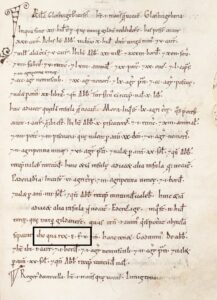
“Ea die qua rex Eduuardus fuit vivus et mortuus” (on the day King Edward was alive and dead) sounds like a riddle, but it is a legal formula referring to 5 January 1066 – the day Edward the Confessor (the last Anglo Saxon king of England) died without an heir. His death set off the struggle for the English crown that ended with the Norman Conquest.
The phrase appears more than 2000 times in the Exon Domesday, where it is often abbreviated to “die qua Rex E.F.V.”. The Exon Domesday is Exeter Cathedral’s remarkable regional draft of William the Conqueror’s famous Domesday survey of 1086. It is a working document compiled at great speed in a matter of weeks. It is no wonder scribes shortened common phrases like this throughout the text! In the final version of the Domesday Book it is reduced further to simply “T.R.E.” (Tempore Regis Edwardi), or “in the time of King Edward.”
Edward’s story is especially close to the Cathedral’s own. In 1050, he moved the bishop’s see from Crediton to Exeter, appointing his friend and chaplain Leofric as its first bishop, and thus establishing the Cathedral.
Edward was canonised as a saint in 1161, and his feast day is commemorated on 13 October. That is the date in 1163 when Thomas Becket, as Archbishop of Canterbury, transferred his body to a new shrine at Westminster Abbey.
This year, that date also coincides with the opening day of the Cathedral’s Autumn Fair. Come along and find us at the fair – we’d love to tell you more about Edward the Confessor and the documents in the Cathedral Archives.
This striking page from the Exon Domesday – all about the lands around Glastonbury Abbey – is now on display in the Cathedral Treasures Exhibition.
Photo: part of Exon Domesday focusing on Glastonbury Abbey currently on display in the Treasures Exhibition